Sunday, May 23, 2010

Blog Transfer

The Insular Empire blog has been MOVED. Please visit theinsularempire.com for blog postings, background info, and updated information on The Insular Empire.

Many thanks to Lara Kroeker at Randomlink Interactive for revamping The Insular Empire blog and website!.

Thursday, May 20, 2010

A New Battle for Okinawa

Globalpost.com - which, by the way, is a great new online source for international news - just posted this excellent little piece about the ongoing protests to the presence of US military bases in Okinawa. Sadly, Guam gets only a minor mention - as the proposed location for the Marines the Okinawans want so desperately to get rid of. But since the Okinawans have been protesting, loudly, for eight years straight (or 60 years, depending on how you qualify 'protest'), I can see how they might get a bit more of the limelight. Guam's situation is so much more complicated, and so much harder to encapsulate in a short news piece...

Wednesday, May 12, 2010

Yapese Canoes Land on Guam

Larry Cunningham, Guam historian and long-time supporter of The Insular Empire, sent me this recent news of a remarkable voyage using celestial navigation. He writes:


Two Traditional Navigation Society outrigger sailing canoes departed Lamotrek for Guam on Monday, April 26th. Their plan was to sail north and pass to the east of Guam, sailing between Guam and Rota to approach the Hagatna Boat Basin Channel from the North.  But because of the strong current, this plan changed and they came to the Hagatna Boat Basin Channel from the Southwest, four days late, arriving on April 30th.  The canoes had sailed over 400 miles of open ocean, braving strong winds, high seas and rainy weather.

The two large (over 30 ft. long) ocean-going canoes anchored at the TASI (Traditions About Seafaring Islands) canoe house,  Sahyan Tasi Fachemwan, where they plan to stay, according to TASI President Frank Cruz.  The key organizer in Guam is Former Federated States of Micronesia Yap State Governor Robert Ruecho, who is operating from the Office of Guam Governor Felix Camacho.

Lamotrek Master Navigator, Ali Haleyalur, is captain of the Simion Hokule’a, a canoe built on Satawal.  He has a crew of 11.  Maap (Island in Yap) Master Canoe Builder, Chief Bruno Tharngan is captain of the Mathow Maram.  He has a crew of nine. Dr. Eric Metzgar is making a documentary film of this voyage from Lamotrek to Guam and then to Yap. Metzgar was an apprentice of Halayalur’s late father, Master Navigator, Urupiy.  Metzgar has made several documentary films about Micronesia, including “Spirits of the Voyage.”

This voyage is unique because the crews are outer atoll Carolinians and high island Yapese.  Also, the return voyage will be from Guam to Yap and this direct voyage of over 500 miles is not documented in credible historical accounts.

The purpose of this Carolinian and Yapese voyage is to put into practice the skills Ali is teaching in the programs of the Traditional Navigation Society in Yap.  They aim to keep this tradition of non-instrument navigation alive.  This is also the goal of TASI in the Mariana Islands.  Chamorro, Yapese, and Carolinians have a strong tradition of voyages of discovery that predate Columbus and Magellan – not by a hundred or two-hundred years, but by over 3,000 years.  Without these ancient seafaring skills there  would not be the rich and diverse cultures found in Micronesia today. Contemporary voyages like the one undertaken by Ali and Chief Bruno honor that proud tradition and the cultural identity of all Micronesians. 

Spanish colonization of the Mariana Islands in the late 17th century put a stop to the trade between the Central Caroline Islands and the Marianas.  The Spanish-Chamorro Wars and the introduced foreign diseases made it dangerous to visit the Marianas for many years.  After nearly a century, in 1787, Chief Lewito of Lamotrek re-opened the trading route from Lamotrek to Guam. He made the voyage to obtain iron tools.  By 1804 the trading visits became annual events and in 1816 some Carolinians from Satawal and Elato settled in Saipan. The descendants of these Carolinians and subsequent migrations of Carolinians form a vibrant community in the Mairanas today. 

Long Live the Navigators!

Tuesday, May 11, 2010

Standing Army

I'm not sure how I missed this - but I can thank Evergreen State College professor of Geography Zoltan Grossman for bringing a new documentary to my attention: Standing Army, by Thomas Fazi and Enrico Parenti. While The Insular Empire explores the human face of American empire in the Marianas, Standing Army connects the dots of America's 766 military bases worldwide. As Chalmers Johnson says in an interview for the film, "The unit for the American empire is not the colony, it's the military base." What makes the Marianas so complicated, of course, is that they are both.


Prof. Grossman, in an interview for the film, asks a question that helps explain everything that's happening right now in Okinawa and Guam: "Are these bases being built to wage the wars - or are the wars being waged to build the bases?"

Thursday, May 6, 2010

Evergreen State College Screening


Tuesday's screening at Evergreen State College was a huge success. Sponsored by the college's Asian Pacific Islander Coalition, and spearheaded by Evergreen student and Guam native Jayanika Lawrence, the screening was well-attended by both students and faculty. Ms. Lawrence had put together an information table full of books on the Marianas and American colonization, and also created a panel - comprised of herself, myself, and one other student from Guam - to answer questions from the audience after the screening. Their questions were incisive and intelligent - ranging from issues around the current military buildup and Guam's relationship with Okinawa, to questions about why we chose not to address environmental concerns (such as Guam's notoriously invasive brown tree snake) in the film.

Evergreen is an odd place - nestled in a rain forest, its 70's era cement brutalist buildings look inward at each other, ignoring the lush thickets surrounding them - but the people there were warm, welcoming, and very much engaged. One faculty member in particular, Dr. Zoltan Grossman, mentioned during the Q&A that he was planning to use the film in his course on a People's Geography of American Empire - a more fitting title than any I could have invented myself - and suggested that they might want me to come back again next year. I told them that I'd be delighted.


Yours truly (Filmmaker Vanessa Warheit) with Jayanika Lawrence (third from right) and members of Evergreen's Asian Pacific Islander Student Coalition.

Sunday, May 2, 2010

Two West Coast Screenings This Month

I'm pleased to announce two public screenings of The Insular Empire happening this month:

Evergreen State College
Olympia, WA
May 4th, at 4pm
Vanessa Warheit will be at this screening to answer questions afterwards.

Cal State University East Bay
Hayward, CA
May 15th, at 4:30pm
Dr. Hope Cristobal will be at this screening to answer questions afterwards.

For more information on the Hayward screening, see the Famoksaiyan blog.

Friday, April 30, 2010

Newsy.com has found Okinawa... Let's hope they find Guam next.

Newsy.com - a kind of online video news aggregator - just ran this story on the Okinawa base relocation. Unfortunately, this story didn't include Guam's (fairly major) role in the relocation debate - but maybe the next one will?

Tuesday, April 27, 2010

Earth Day - from San Francisco to Okinawa and Beyond

My son asked me the other day, "Mommy, what's Earth Day?" When I explained it to him ("Well, honey, it's a day when we celebrate the Earth and try to remember to help keep it healthy"), I felt a little bit ashamed. Without the Earth there is nothing - so why do we only give it one day?

On the other hand, Earth Day does give a lot of groups who are fighting for the Earth a platform to get the word out. This past week (Earth Day seems, happily, to be bleeding into Earth Week) there were many actions to draw attention to the US military's plans for increased presence in the Asia-Pacific region.

Famoksaiyan, in collaboration with several other organizations, held a press conference across the street from the EPA’s Earth Day Festival at Yerba Buena Garden. "The massive build up on Guam directly contradicts efforts to protect our environment from global warming,” said Reverend Deborah Lee, a member of Women for Genuine Security, the local chapter of a global women’s network that works to protect the health and safety of communities around US military bases. “The US military has an enormous carbon footprint which must be addressed for the health of local communities and the security of our entire planet.”


Meanwhile, on Okinawa, nearly 100,000 people turned out to protest the planned relocation of the US military base from Futenma to Henoko (or anywhere else in Okinawa). In South Korea, Catholic fathers held a Peace Missal against proposed construction of a nuclear weapons naval base on Jeju Island. There were also solidarity rallies held in Washington, DC and in Hawaii.

Monday, April 26, 2010

Casino Jack Hits the Big Screen (x2)

Several years ago, a Washington lobbyist named Jack Abramoff got himself - and some high-up politicians like Tom Delay - into a whole lot of trouble. I am familiar with the Abramoff story because one of the many unsavory episodes in his outrageous career involved lobbying to keep US labor laws out of the CNMI. When the scandals broke, a lot of people were suggesting that I turn my documentary lens on Abramoff. It was tempting - it was a story almost too good to pass up - but I'd already shot most of The Insular Empire and didn't have the resources to start a new film from scratch.

But it appears some other filmmakers recently picked up that ball. Next month will usher in not one but two films about Abramoff -- with distinctly similar titles: Casino Jack (a narrative feature starring Kevin Spacey) and Casino Jack and the United States of Money (a documentary by Alex Gibney).


The Gibney film looks fantastic (the narrative feature still doesn't have a trailer posted). But I'm curious to see how Gibney will treat the issue of the CNMI and its attempt to maintain control over its labor laws. So far, I have yet to see anything about the Abramoff CNMI scandal that addresses the fundamental, underlying problem of the CNMI's political status, or its colonial history. Similarly, it will be interesting to see how the Indian tribes (for whom Abramoff also did a lot of dirty work) are treated in the film. The level of audacity and flamboyance in Abramoff's dealings - including massive bribes and outrageous kickbacks - seems to have overshadowed any real investigation into the root causes that forced these indigenous groups to rely on people like Abramoff to begin with. The jury is still out on whether these new films will finally change that trend.

Thursday, April 22, 2010

Radiation? What Radiation? Happy Earth Day!

What a great way to celebrate Earth Day: According to an article in today's Marianas Variety, "Guam Vice Speaker B.J. Cruz is protesting the U.S. Environmental Protection Agency’s policy decision to not require radiation testing for dredged materials from Apra Harbor that would be dumped into the proposed ocean disposal site."

As Vice Speaker Cruz stated in his letter to the EPA: “It is common knowledge that the U.S. Navy discharged radioactive material into Apra Harbor on more than one occasion. It is imperative, then, that no dredging of the harbor take place until adequate radiation testing independent from that reported by the U.S. Navy has been conducted on proposed dredge sites.”

Last week, after learning that the EPA was requesting public comments on where to dump the 'dredged waste' (aka 71 acres of living coral reef, some of which may or may not be radioactive) from the bottom of Apra Harbor, I wrote the following letter to the EPA:

To: ota.allan@epa.gov
Subject: designation of an ocean disposal site outside Apra Harbor

Dear Mr. Ota,

I would like to express my surprise and dismay at reading in today's Guam Pacific Daily News that the EPA is requesting recommendations for a place in which to dump dredged material from Apra Harbor. It is my understanding that the EPA recently ruled that the military's plans to dredge 71 acres of coral reef within Apra Harbor were in violation of the Clean Water Act AND the Endangered Species Act, and that the project was of “sufficient magnitude that EPA believes the action should not proceed as proposed.”

It is also my understanding that the DoD DEIS -- which claims that "there will be no overall unacceptable adverse impacts to water quality with ocean disposal" -- does not address the issue of radioactive sediment in Apra Harbor. Is the EPA seriously considering allowing the military to use radioactive dredged material for landfill -- and then finding some place in the ocean where this dredged material will create 'no overall unacceptable impacts to water quality'?

Finding such a site is not only ecologically reprehensible in itself - it also sends the message that the dredging is still possible. I'm not sure what mechanisms are at your disposal, but I strongly urge you to refuse to consider ANY disposal site designation entirely, until the issue has been resolved of whether or not to dredge the harbor in the first place.

Thank you for your time and attention,

Vanessa Warheit

Wednesday, April 21, 2010

Memories of Saipan

Shortly after The Insular Empire aired on KCTS, I got a phone call from a viewer who wanted to correct something she thought was inaccurate. Pete's story had indicated that there was no high school on Saipan - but she herself had attended high school there. I asked her what year that was, and she told me it was in the late 60s. I explained to her that Pete was older than she was – he attended high school in the 1950's – and that it wasn't until the Kennedy administration and the lifting of the security clearance in the Marianas that Saipan finally got a high school.

The viewer, whose name turned out to be Sue Morrow Flanagan, followed up later with a wonderful email describing more of her experiences in Saipan during that time. Here is an excerpt:

"Our family moved to Saipan as part of a business venture that didn't work out for my father. Until I spoke to you this afternoon I hadn't realised the Kennedy period was a period of such transformation.  Although, the greatest measure of transformation came on my last flight home.  We boarded a crowded flight from Guam to Hawaii.  I was moved to a seat away from my family and tucked in next to a Navy man.  He was Capt. McLinnis who was returning to Pearl Harbor to accept command of the USS Ticonderoga and would then return to Vietnam.

I should explain that I became a journalist to cover for my socially inappropriate curiosity.  Indeed, my mother swears my first word was "Why?"  I was grilling the Navy officer immediately.  He turned the tables and asked about Saipan. He knew every landmark I mentioned from our home in Garapan to Capitol Hill. Finally, I asked him when he was on Saipan and for how long. 

"I have never been there."  He replied.  Of course I maintained that was impossible.  How could he know so much detail?

"I bombed it for weeks from an aircraft carrier." he grimaced.  To my horror, he described the utterly ravaged landscape.  Another carrier group had inflicted severe damage in another Micronesian island group as well, he said with a strange mix of sorrow and grief. Captain McLinnis didn't speak for a minute or two, staring out the window. 

I watched his clenched jaw. I had described a landscape healing its war wounds while he was going on to another war. Despite being a naive, spoiled 16 year-old, I began to understand at a visceral level---- the radical changes Saipan had endured from the Spanish to the Japanese sugar plantations to the war and then our tanga-tanga Americanization.  Who knew that hurricanes, Japanese business and Chinese labor exploitation lay ahead?   Yet, now, none of that is as disturbing as Hope's daughters not speaking their native tongue. I was in Fiji when they claimed their independence and in Apia, Western Samoa soon after their independence.  Both nations reveled in returning to traditional garb, heritage and language. Heritage is a priceless treasure.  The loss of language seems to me a far greater loss than all the other catastrophes.  I do hope your film inspires the Chamorro and Carolinian people to reclaim their heritage.  They are an extraordinary people."

Monday, April 19, 2010

Seattle, Screening, and Samoan Slap-dancing

I had the opportunity to screen The Insular Empire at the University of Washington this past weekend, at the 4th Annual Chamoru and Micronesian Research Conference. After the film, I added a screening of this short video I made in collaboration w/ the folks at We Are Guahan, about the proposed military buildup of Guam:


And on a lighter note: I also got to attend the Seattle University annual Fiesta - where I saw some awesome Chamoru chanting performers. Unfortunately I didn't have the presence of mind to get any good footage of them -- but  I did get my camera out in time to shoot the Samoan slap dancers, who reinforced my belief that Samoan dancing men are one of the finest things on the planet:

Thursday, April 15, 2010

Free Seattle Screening THIS SATURDAY, April 17

I will be screening The Insular Empire at the 4th Annual Chamoru & Micronesian Research Conference this Saturday. The film will be screening at 3pm at the University of Washington's  Ethnic Cultural Center - 3931 Brooklyn Ave NE, Seattle - in the Black Room. Many thanks to Migetu Tuncap for making this possible at the last minute!

Please join us if you can...

Tuesday, April 13, 2010

Sign the Petition - Halt the Guam Buildup


On Earth Day (April 22), several groups will gather outside the US Environmental Protection Agency’s Region 9 Building in San Francisco,  demanding a halt to US military expansion on the Pacific island of Guam. They will present a petition, urging the White House to:

* halt current plans for the military buildup of Guam
* re-write the military's Draft Environmental Impact Statement
* limit the military to its current footprint on Guam
* clean up existing military contamination on Guam
* increase federal funding to strengthen Guam's inadequate infrastructure.

As this blog has discussed earlier, the EPA ruled earlier this year that the military's current plans for Guam are "of sufficient magnitude that EPA believes the action should not proceed as proposed." The proposed buildup would (among other devastating effects) destroy 71 acres of coral reef, overwhelm Guam's fresh water supply, wipe out endangered species, and turn protected ancestral lands into a live-firing range. It would also cost US taxpayers $9 billion.

Please sign the petition, and ask your friends and family to do the same.

Saina ma'ase (thank you) to Erica Benton of Famoksaiyan for creating this petition and for bringing it to my attention!

Monday, April 12, 2010

"Red Pill Tour" of O'ahu - Part Two

This is a long-overdue continuation of the amazing - albeit sobering - tour of O'ahu I took with Lino Olopai and Dr. Hope Cristobal. Terri Keiko'olani and Kyle Kajihiro of DMZ Hawaii were our tour-guides, and like all good tourists, we started at the USS Arizona memorial. The US Parks Service has recently installed at the memorial a giant outdoor map of the Pacific (showing, as Kyle pointed out, America's "Pacific Lake"). Lino and Hopie put their feet on their respective islands - and Lino had a long and interesting conversation with some folks visiting from Kiribati.

I was totally confused by the names of the islands on the map (Kiribati wasn't even listed), until I realized that the map represents not how the world is today - but how it was in 1941. (The USS Arizona is, after all, a history museum.)

Then Kyle took us off the paved path, to a section that other tourists didn't seem to notice: the edge of the lagoon itself. Here is a video (shot with my iphone - forgive the technical shortcomings) of what we learned there:


After Pearl Harbor, Kyle and Terri took us for yummy plate lunch - and then to the dry west side of the island, to see how the military and the native Hawaiians are not-so-peacefully coexisting outside of the visible tourist areas. But that story will have to wait for another post...

Tuesday, April 6, 2010

Japanese Subtitles (日本語字幕)

I want to give a shout-out to two incredible Japanese translators, who have generously donated their time, expertise, and energy to translating The Insular Empire into Japanese.

Masumi Mukai is a member of the Japanese group Translators United for Peace. She took on the task of translating the film's transcript, reviewing it with other TUP translators for accuracy, and sending me a finished Japanese transcript for The Insular Empire.

Shoko Hata, a student here in Vancouver at Simon Fraser University, has been my personal babelfish, sitting with me for long hours to help place Masumi's translation into subtitles on The Insular Empire DVD. I plan to have the Japanese translation complete this week, and Japanese-subtitled DVD's ready for sale soon after.

Thank you!!

Next on my list: Spanish subtitles. Please contact me if you're interested in translating The Insular Empire into Spanish!

Monday, March 29, 2010

University of Hawaii Law School to Host Talk on Proposed Guam Buildup

Desiree Taimanglo-Ventura recently posted this notice of a discussion to be held at the UH Manoa Law School on April 1st. (And no, don't get your hopes up that the proposed buildup will be revealed as a massive April Fool's joke!) Vice-Speaker B.J. Cruz of the 30th Guam Legislature is the keynote speaker. He will be joined by Dr. Wendy Wiltse of the U.S. Environmental Protection Agency (Region 9).

The Guam Military Buildup:
Examining Potential Impacts on Culture, Environment, the Economy and the Larger Community

University of Hawai'i Law School Moot Court Room
or 
WATCH IT LIVE, ONLINE: www.KaHuliAo.com
 
Hawai'i Standard Time
Thursday, April 1, 2010 
12:45 – 1:55 p.m 

Chamorro Standard Time
Friday, April 2, 2010
8:45-9:55 a.m 

Friday, March 26, 2010

Guam Buildup: Environmentally Unsatisfactory

The DoD's proposal to increase its already-massive footprint on the island of Guam recently received the EPA's lowest rating: Environmentally Unsatisfactory. While "unsatisfactory" to me calls up benign images of less-than-optimal spelling homework, this milquetoast language in fact represents a scathing indictment of the proposed buildup – and a serious roadblock to the military's expansionist plans.

We Are Guahan has posted a great ten-point summary of the EPA's findings on their website. The problems identified by the EPA include:
  • contaminated drinking water
  • "unacceptable," island-wide water shortages
  • endangerment of Guam's aquifer
  • "unprecedented" destruction of Guam's coral reefs
  • inadequate protection of endangered wetlands
  • lack of commitment to energy efficiency, renewable energy, and cleaner fuels
  • over eight TONS of hazardous waste generated
  • lack of mitigation to likely PCP contamination
  • no discussion of treatment of radioactive waste
  • significant noise impacts
  • invasive species introduction
 ... and the list goes on and on. You can read it yourself - the report is a handy 101-page download, with a succinct table of contents outlining the 1,001 reasons why THIS BUILDUP IS A REALLY BAD IDEA, from an environmental standpoint.
 
Of course, it's a really bad idea for a number of other reasons too. For instance, it threatens to overwhelm the island's indigenous population and to further erode the Chamoru culture and language. But the US government doesn't have an Indigenous Culture Protection Agency to make these points.

The current focus on environmental issues calls to mind a conversation I had, several years ago, with the late Carlos Taitano. He said that he was frustrated when the two-legged Guam Rail raised so much concern among environmentalists, who seemed to have no concern for the local population. "What about the two-legged Chamorro?" he asked.

Admittedly, it's frustrating when environmental concerns trump the concerns of a people, culture, and language. However, in the case of the Guam buildup, I think that environmental concerns may dovetail nicely with the needs of the local population – whose drinking water, air quality, and health are being so overwhelmingly threatened by the DoD's proposal. Since the US military wouldn't dream of trying to impose this kind of a project on mainland Americans, it's my hope as well that the proposed buildup will bring Guam's colonial status out into the light of day. Because sunshine is the best – and the most environmentally friendly – antiseptic .

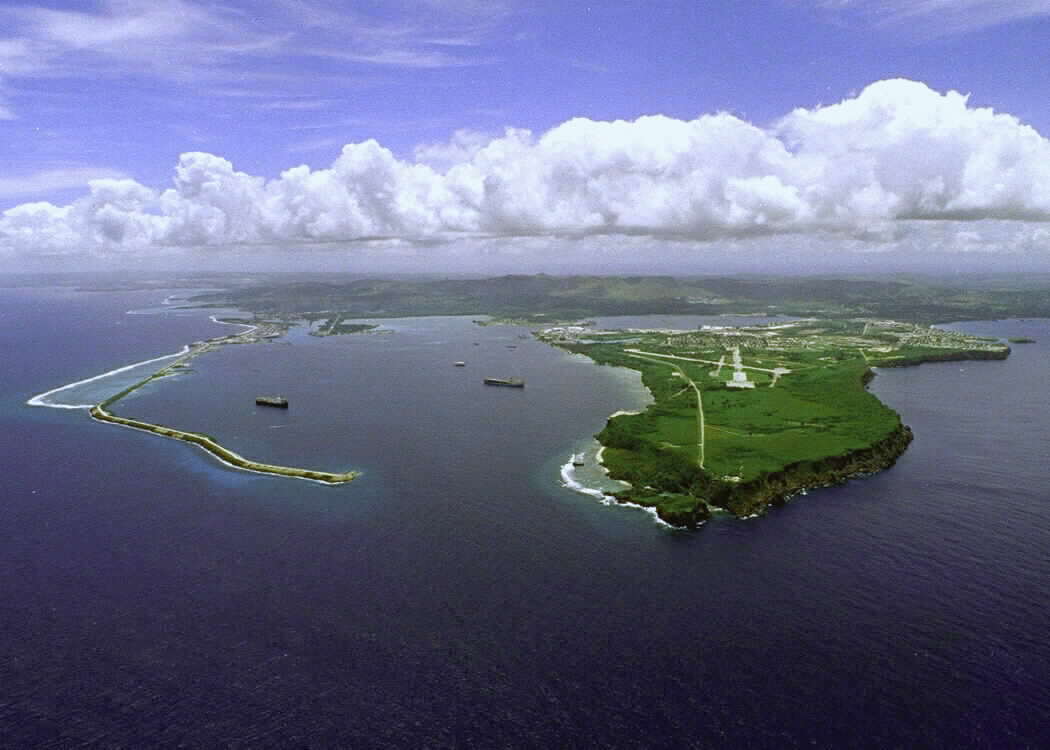
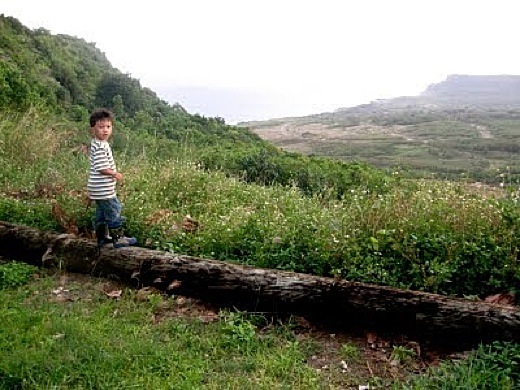
(Photos courtesy of Desiree Taimanglo-Ventura at The Drowning Mermaid, and David Burdick at the US All Islands Coral Reef Committee)

Tuesday, March 23, 2010

Obama: The Velvet Imperialist

The ever-helpful Jean Downey just forwarded me this article in the Huffington Post by John Feffer.

In it, Feffer describes a recent Congressional hearing on currently-strained US-Japan relations - in which a Pentagon official was unable to come up with the number of US troops stationed in Japan (47,000), or to explain why the US needs more than 700 overseas bases worldwide. (I thought the number was just under 900, but who's counting?) Feffer writes:

"The Pentagon official couldn't satisfy either Rohrabacher's anti-China tirade or Faleomavaega's probing questions about the U.S. empire of bases. And that's precisely the problem with the Obama administration's Pacific policy. We are trying to maintain the exact same force posture as previous administrations but at the same time emphasizing our new commitment to multilateralism and our new status as a "global partner." It's like Arnold Schwarzenegger going from Terminator to Kindergarten Cop in the space of a year: Audiences above the age of seven are just not convinced."

Obama, Feffer argues, is trying to run an empire with velvet gloves - an approach that will be fruitless for either building or dismantling it. We shall have to wait, he says, for "an insider who knows the system," such as Andrew Bacevich, to "pull the plug" and offer real Pentagon reform.

I also really like the Swiftian 'modest proposal' that Feffer concludes with. What shall we do with all those US Marines in Futenma? Why, move them to Washington, DC!

"If the prospect of having U.S. Marines involved in promoting democracy, maintaining stability, and responding to humanitarian crises at home makes you squeamish," he concludes, "you can begin to understand how the Okinawans might feel."

Sunday, March 21, 2010

The Washington Post Finally Discovers Guam

It was bound to happen eventually - The Washington Post finally ran a comprehensive (and pretty critical, I might ad) article in tomorrow's paper on the proposed military buildup of Guam. (Yes, that's right. Tomorrow. Today is the 21st, and the by-line is the 22nd. Don't ask me. Maybe it's an international dateline thing.)

Anyway. My favorite quote in the article is from Simon A. Sanchez II, chairman of Guam's commission on public utilities:"We don't mind being the tip of spear, but we don't want to get the shaft."

And I'm thrilled to report that the final quote is from none other than the fabulous Dr. Natividad:
"This is old-school colonialism all over again," said LisaLinda Natividad, an assistant professor of social work at the University of Guam and an activist opposing the buildup. "It boils down to our political status -- we are occupied territory."

http://www.washingtonpost.com/wp-dyn/content/article/2010/03/21/AR2010032101025.html